Mariko Teasing Harunyan on ANN Radio Show

Featured


On the December 10, 2011 episode of the ANN (All Night Nippon) radio show, Miichan, Mariko-sama and Harunyan were the hosts. During one of the segments, Mariko thoroughly enjoyed teasing poor Harunyan. The topic was “if senbatsu ◯◯◯◯ existed, who would be the top three chosen AKB48 members?”

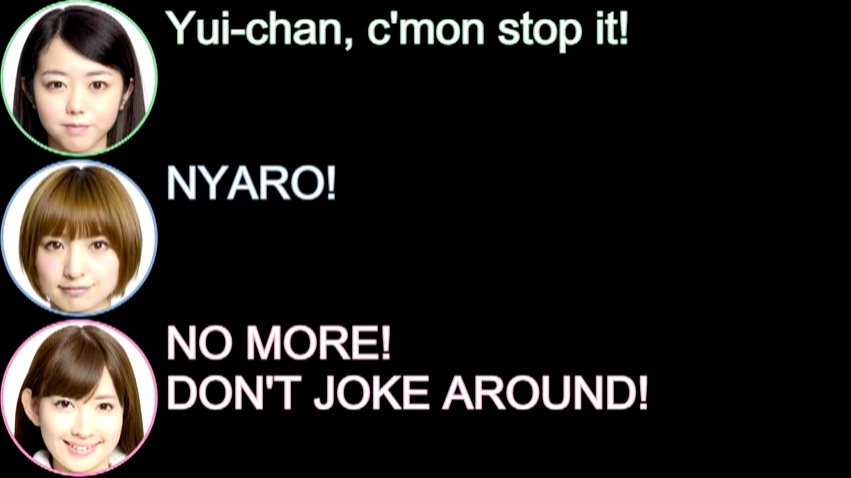
Mariko teased Harunyan hard by always answering “Nyaro” (a nickname for Harunyan that only Mariko uses) as her senbatsu member, no matter what the topic was. For the first topic (“is popular with kids”), Harunyan was initially genuinely happy that Mariko picked her. However, when she realized that Mariko was messing with her, she started getting flustered.

For the second topic (“makes you think ‘she eats fast’!”), here’s how the conversation went:

Mariko: NYARO!
Minegishi: Yui-chan. Wait, c’mon stop it!
Haruna: NO MORE! DON’T JOKE AROUND! (`д´)
Minegishi + Mariko: *laugh*
Haruna: WE’RE CHOOSING A FAST EATER SO WHY DID YOU SAY NYARO!?
Minegishi + Mariko: *laugh*
Haruna: DO IT SERIOUSLY! PEOPLE WANT TO KNOW!
Minegishi: Hey, what’s going on? *laughs* What’s going on with you two?
Haruna: IF IT’S GOING TO BE LIKE THIS, THEN I’D RATHER DO THE PARODY SONGS SEGMENT.ヽ(`Д´)ノ
(The parody song segment is something Harunyan hates doing)
Minegishi + Mariko: *laugh*

For the third topic (“you can tell when she gets flustered”), Miichan gets into the trolling action too.

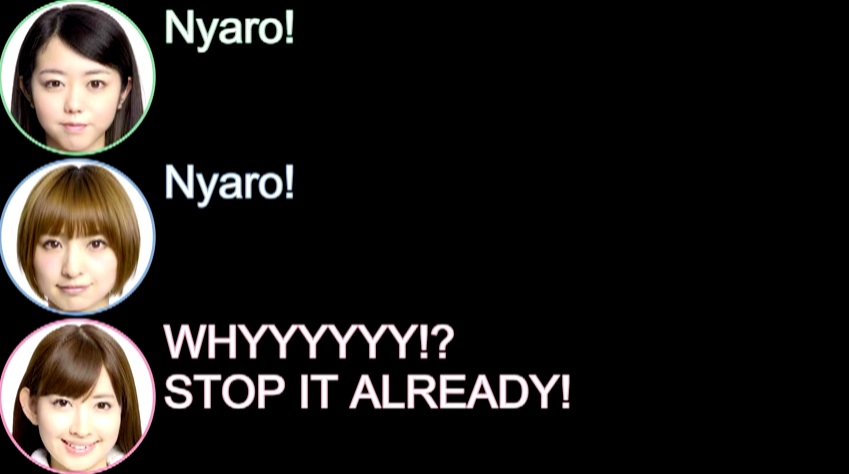
Minegishi + Mariko: Nyaro!
Haruna: WHYYYYY!? STOP IT ALREADY!
Minegishi + Mariko: *laugh*
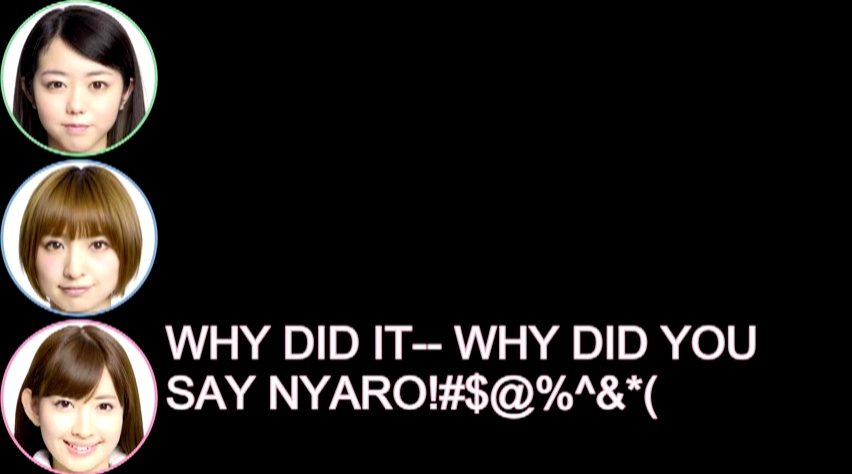
Haruna: WHY DID IT — *sighs* WHY DID YOU SAY NYARO *covers her face with her hands* !#$@%^&*(
Minegishi: *while laughing* I don’t know. I don’t know either.
Haruna: How did you end up wanting to say Nyaro?
Minegishi: I don’t know… Because I got winked at. *laughs* Mariko winked at me so I said it!
Haruna: Aaaaaahhh…
Mariko: You get upset all the time.
Minegishi: *laughs*
Haruna: Is that true?
Mariko: It’s not. I just wanted to say it. *laughs*
Haruna: HEY!  Haaaaaaahh… (´Д`)ハァ…

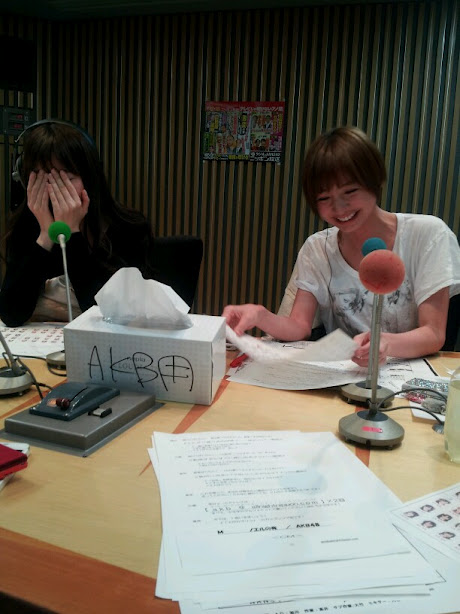
Harunyan getting teased was sooooo entertaining to listen to. She wanted to do the segment seriously but Mariko just kept derailing it. A flustered Harunyan is the best ( ´ー`). About halfway through the segment, Miichan took a picture of Mariko and Harunyan which you can see at the top of this post. You can clearly see Harunyan’s exasperation and Mariko’s huge grin and troll face.

This post is the Cliff’s Notes version of the seven and half minute long clip. You can listen to the subtitled version of Mariko’s trolling in this Youtube clip:
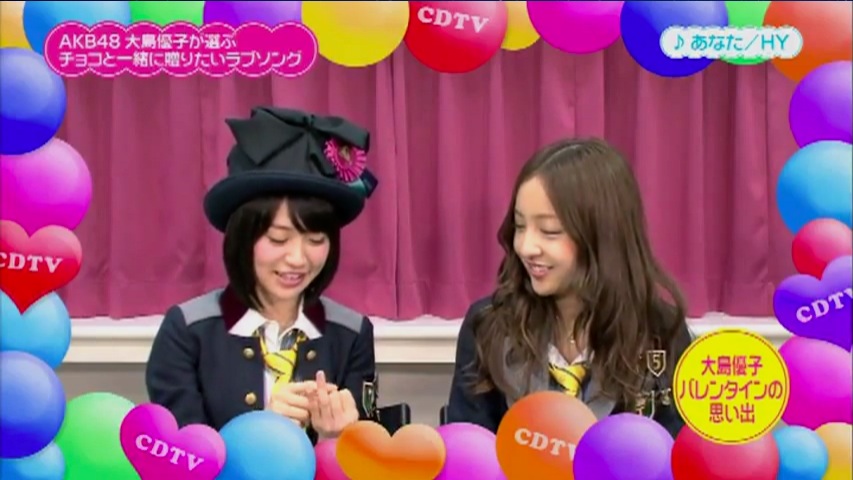
Yuko Oshima’s (Bitter) Valentine’s Day Memory

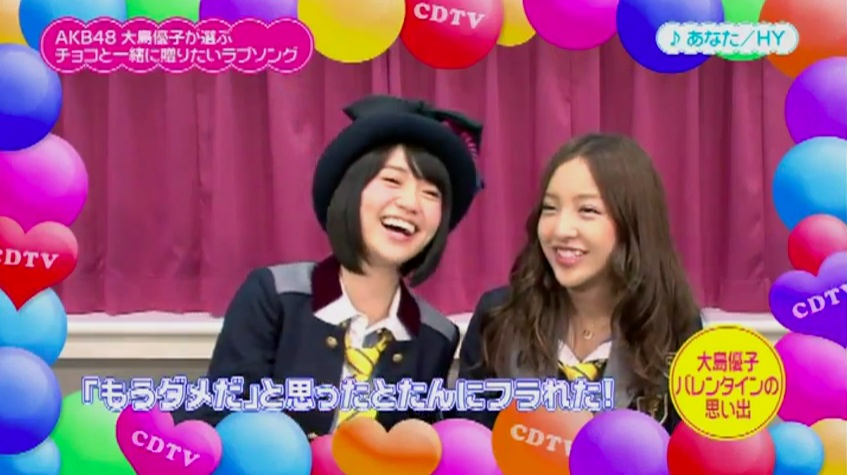
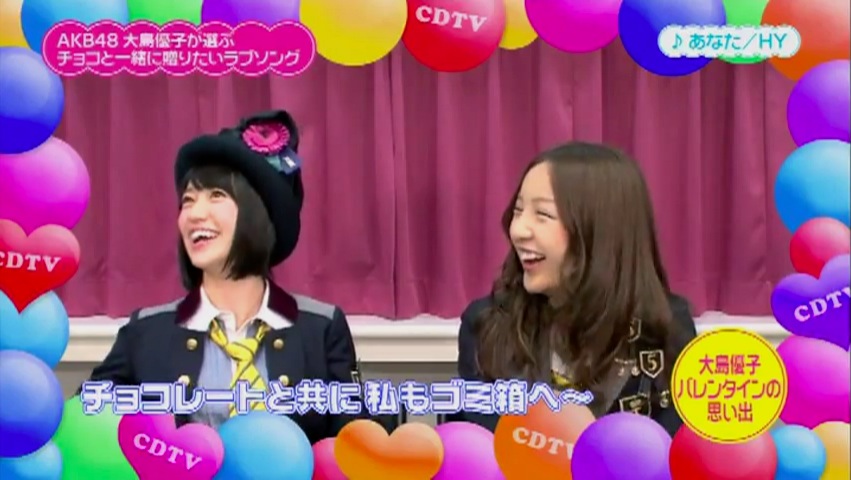
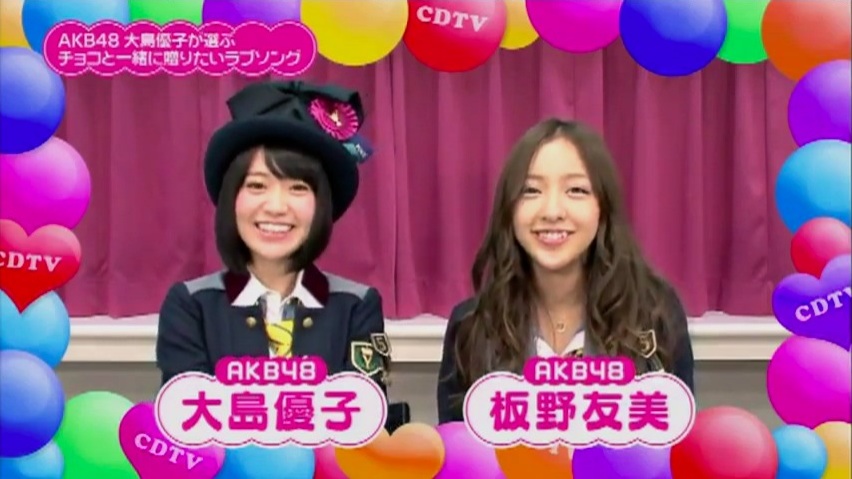
On the music show “Countdown TV” that aired on February 11, 2012, Yuko Oshima and Tomomi Itano had a small talk segment where Yuko talked about her Valentine Day’s memories. She mentioned that most of the ones that she could think about were shocking events.

One of these shocking events occurred when she was in middle school. She had a boyfriend at the time so for Valentine’s Day, she made him some chocolate. However, they both went to different schools so it was hard for them to see each other. Even though she made chocolate and wanted to give them, she wasn’t able to. A whole month after Valentine’s Day, Yuko still hadn’t given her boyfriend the chocolate! By that time, it had spoiled.

Being unable to meet face to face, they used to communicate through e-mail. During one of those exchanges, Yuko told her boyfriend that the Valentine’s Day chocolate had gone bad. He answered by saying “That’s no good,” and decided to break up with her at the same time.  With her usual humor, Yuko summarizes the situation by saying “So the chocolate and myself were both thrown into the trash together!”

Kind of funny how Yuko has no good memories of Valentine’s Day. That guy must be kicking himself today for having dumped Yuko!

Yuko Flipping the Bird

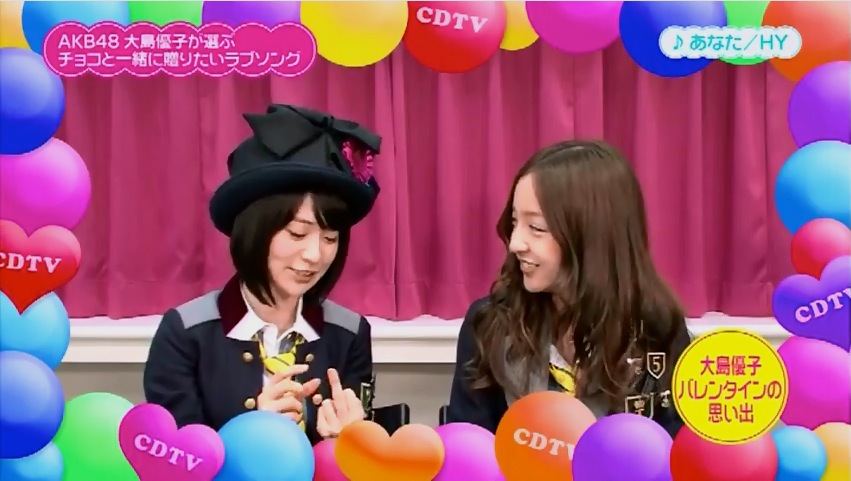
Something I noticed during the talk segment was that Yuko inadvertently gave the middle finger to the camera while telling her story ( ゚д゚ ). When she was saying that her Valentine’s Day memories were bad ones, she used her fingers to count the number of memories she could recall. She then goes to say “The one I’ve decided to talk about…” and at that moment, raises her middle finger. It was totally unintentional, but I found it amusing 🙂

Use of Kanjis and Polite Speech

I recently read a diary written by pea-san on Lang-8 that was quite interesting. After correcting many entries written in Japanese, she noticed some mistakes that Japanese learners often make. According to her, what is explained here is difficult, even for some Japanese people.

The following is a translation of what she originally wrote in Japanese. I’ve changed a couple of parts to emphasize some of her points. I hope my translation didn’t butcher the explanations too much ^^;

Link to the original article: http://lang-8.com/281195/journals/1010908/


1. About Kanjis

It’s really great to know lots of kanjis. However, when you use too many of them, sentences actually become harder to understand.

Example)
今晩は。昨日は吃驚させて御免なさい。
今日は凄く嬉しかったです。有難う。
終電結構混雑してたんじゃ無いですか?
明日は八時三十分に会いましょう。
宜しく御願い致します。

Translation)
Good evening, I’m sorry for surprising you yesterday.
I was very happy today. Thanks.
The last train was quite crowded, wasn’t it?
Let’s meet tomorrow at eight thirty.
Please take care of me.

In the above example, you can notice that kanjis are used a bit too much. (The content of the sentences is random, so don’t pay too much attention to them.)

Corrected Example)
こんばんは。昨日は驚かせてごめんなさい。
今日はすごく嬉しかったです。ありがとう。
終電は、かなり混んでいたんじゃないですか?
明日は8時30分に会いましょう。
よろしくお願いします。

Of note, numbers are most of the time not written with kanjis. Occasionally, it’s also better to change the structure of a sentence so that it’s not full of kanjis.

2. Using Polite Speech (丁寧語、です・ます調)

For people who use polite language, please pay attention to how you conjugate the verb ending. If you use polite speech, then it’s better if everything is written with polite speech.

Example)
それは、私にとって初めての海外旅行でした。
とても楽しかった。
また行きたいです。

Translation)
This was my first overseas trip.
It was lots of fun.
I want to go on a trip again.

Corrected Example 1)
それは、私にとって初めての海外旅行でした。
とても楽しかったです。
また行きたいです。

Corrected Example 2)
それは、私にとって初めての海外旅行だった。
とても楽しかった。
また行きたい。

Either of the corrected examples are acceptable. The first set of corrected sentences uses only polite form while the second one uses only plain form.


So the big idea is to not go crazy on kanjis and to remain consistent with verb conjugation. If the text is written in polite form, then everything should be conjugated to polite form. If it’s written in plain form, then everything should be in plain form. Mixing both is a no-no.

I know that I have problems with both issues raised in this article. I use a bit too many kanjis and I’m inconsistent in verb conjugations.

I wonder what’s the secret ratio of kanjis to kana? In my case, it’s sometimes hard to gauge whether a word should be written with kanjis or not.

英語を上達させる簡単なコツその1:カタカナの英訳

カタカナを英訳する時、すべての文字を大文字で書くのは必要はありません。小文字で書くので充分です。カタカナで書いてある名詞は、固有名詞の場合、一番目の文字だけが大文字になります。他方、カタカナで書いている名詞は、普通名詞の場合、すべての文字は小文字にします。

例文その1:山田さんはアメリカに住んでいるジョンさんに手紙を送った。
○ Yamada-san sent a letter to John-san who lives in the United States.
× YAMADA-san sent a letter to JOHN-san who lives in the UNITED STATES.

例文その2:ニューヨークのタイムズスクエアはとてもきれいなので、いつかそこに行きたいです。
○ Since New York’s Times Square is very beautiful, I want go there someday.
× Since NEW YORK TIME SQUARE is very beautiful, I want go there someday.

例文その3:佐藤さんの好物はピザとカレーです。
○ Satou-san’s favorite food is pizza and curry.
× Satou-san’s favorite food is Pizza and Curry.
× Satou-san’s favorite food is PIZZA and CURRY.

疑問があれば、ぜひ質問してください。